Showing posts with label health. Show all posts

Tuesday, 11 October 2011

Rosehip Syrup

Adapted from Marguerite Patten's Feeding the Nation.

Makes 2 cups rosehip syrup - enough for 2 people for 6-8 months, if taken as a few drops daily.

Ingredients
1lb rosehips, ripe and red
9oz sugar

Method
1) Wash hips and 'top and tail' (remove stalks and greenery).  Put in a heavy stainless steel pan.  Cover well with water and bring to the boil.  Simmer until tender - about 10 minutes.

2) Mash hips well with a wooden spoon so that they are all broken open.  Put into a jelly bag (see Notes) over a bowl, and squeeze out as much juice as possible.

3) Return the pulp to the saucepan and add the same amount of water again.  Bring to the boil and simmer for another 10 minutes.  Pour back into teatowel and squeeze again into the bowl, adding to the juice from the first round.

4) Bin the pulp, and wash out the teatowel very thoroughly.  (I put mine through the washing machine.)  Pour the juice once again into the teatowel.  Do not squeeze this time, but allow to drip through into a clean bowl overnight, without stirring or pressing.  This should ensure that the liquid is hair-free!

5) Boil the juice down until it measures about 2 cups (16 fl. oz.)  Add the sugar and stir until dissolved.  Boil for 5 minutes.

6) Either:
(a) Bottle the syrup in small jars.  The jars must be perfectly clean and hot - put them through the dishwasher and use immediately, or sterilise with boiling water and keep warm in the oven until ready for use.  Seal the jars at once, using rubber washers to ensure a perfect seal.  The syrup should be stored in a dark cupboard.
or
(b) Do what I did and freeze the syrup in ice cube trays, so that a very little can be defrosted at a time.  I think this works, but don't guarantee it yet!  I'll update this recipe as I find out.


Notes
I didn't have a heavy stainless steel pan, and an ordinary cheap one worked fine!  Just watch a little more closely in case the bottom burns.

I also didn't have a proper jelly bag, and was wary of using a borrowed one in case the little rosehip hairs got stuck in it and spoiled it.  You can improvise a jelly bag with layers of muslin, but I found a simple linen tea towel worked very well, and moreover, was tough enough to endure squeezing.  The red stain washed out fine, at least when I washed it straight away.  Just put a metal sieve over a large baking bowl, and put the tea towel in the sieve to hold everything in place; then pour into the sieve.

Serve as a Vitamin C supplement, taking about 1/4 tsp a day.  Alternatively, pour some over icecream, or use to flavour home made icecream or desserts.

Day 102: Rosehips - The Final Chapter

Well, it has worked!  At least, I have produced a reddish liquid which tastes quite nice, and is suitably syrupy.  I am really rather proud of myself.  What better frugal achievement than a Hedgerow Harvest transformed into a useful foodstuff and medicine?

Good old Marguerite Patten.  Her wartime recipe was just the thing.  She informs me that "This syrup is suitable for infants, very palatable, and so rich in Vitamin C that 1oz is sufficient for 1 month."   The half pound of rosehips I had picked has made 1 cup (8 fl.oz) of syrup, so that means that I am sorted for 8 months, I presume.  That will tide me over even a Scottish winter. :D

Of course, there are still a couple of things that could go wrong.  I think I got all the little hairs, but who knows?  Only time and potentially painful experiment will tell.  And rather than bottling the syrup, I am making use of some technology they didn't have in wartime Britain, and freezing it.  I read somewhere that if you do bottle it, you should use tiny bottles, as it goes off rapidly after opening - about one week.  So I am hoping that freezing offers a good alternative and doesn't destroy the syrup or its nutritional value.  I froze it in a couple of icecube trays, for easy extraction and defrosting.

Anyway, the recipe is posted above.  I am told it can also be used as a flavouring for desserts, or poured over ice cream, which sounds like an extraordinarily pleasant way of taking one's medicine.

So come and get me, Winter Germs!  I am ready for you!

Sunday, 9 October 2011

Day 101: More on Rosehips

I mentioned yesterday how, while foraging, I added some rosehips to the haul.  I did this without much idea what I would do with these, apart from a vague notion that there exists such a thing as rosehip syrup.  So now I have half a pound in the freezer, and have been researching how to proceed.

Did you know that rosehips contain 20 times as much Vitamin C as an orange?  The problem with my source for this factoid is that it doesn't say exactly how it calculates this - pound for pound, or what?  Be that as it may be, they were majorly useful during World War II, where a few drops of the syrup was given to infants on a daily basis.  It therefore occurs to me that if I can make this stuff, it could be the first line of defence against the common cold this winter.  Got to be cheaper than echinacea tablets.

The problem with rosehips (and it is a major one!) is that inside, the little seeds are covered with little hairs.  These hairs are immensely irritating and can, I am told, cause nasty tummy upsets.  And if they get through the tummy without problem, then they REALLY get you on the way out.  I do not speak from experience here, but I am told that the word, 'itchy', does not begin to cover it. 

So when making the syrup, one has to be very careful that none of these little hairs get into the final product.  Hence straining and straining and straining.

Well, I'm off to give it a try.  I'll let you know how it goes, and if it works, I'll post the recipe.  After all, my "Food for Free" foraging book says there are hips still in the hedgerows until November.

Tuesday, 23 August 2011

Day 52: Indigestion

As promised!

I am one of these people who is rather prone to acid indigestion.  I have been for years: I have checked it out with the doctor, and it is just a reflux thing.  I should say at this point that these things should always be checked with a doctor, and that the 'remedies' below are just coping strategies that have helped me, none of which will cure a chronic problem, and none of which are a substitute for medical treatment.  The same goes for any other suggestions made in the comments.

Clearly, the best cure is prevention, and one very good side-effect of this healthier diet has been a lot less acid swilling about my stomach.  I know that if I work my way through a steak-pie-and-chips, I will pay for it.  Apart from heavy greasy food, chocolate and fizzy drinks are two of the worst culprits, but happily, both of these have been all but eliminated from my diet..  But the problem is still there, even with healthy eating, so it helps to have a few more direct remedies to hand.

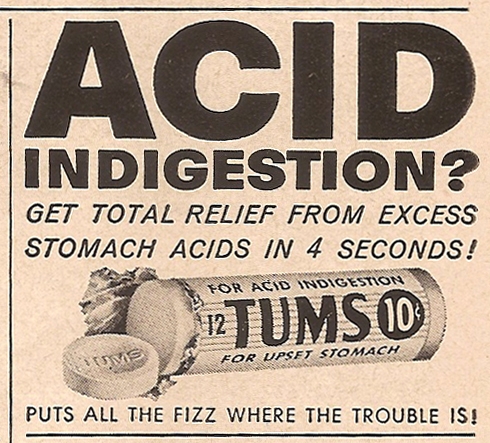
Up till now, I have contented myself with always having a copious supply of antacid tablets to hand.  We are very lucky in the UK that these can simply be picked up at the supermarket: when I lived for a few months in Germany, I had to buy them over-the-counter in the Pharmacy, where they cost nearly 6 euros a time.  (Asking for them the first time was quite a test of my limited German, and was accompanied by some expressive mime.)  But you know, even back in Blighty, these little sweeties can be very expensive.  A packet of 24 Rennies, for example, usually costs over £2, and if the bout of indigestion is bad, I can get through that in less than two days. That means I could easily chew my way through about £6 a week.  Not an option for the Frugalist.

Nevertheless, the little sweeties are useful to carry about in a bag or pocket, and so it is worth knowing that the cheapest I have found is Asda's own brand.  Here you can get 4 handy tubes of 20 each for only £2.  By comparison, Tesco charges £2 for a packet of 48, and Boots currently charges £1.62 for 48 of their own brand.  Quite a difference.  But if you know of any cheaper ones, please do let me know.

When at home, however, I have been resorting to the disgusting but effective old remedy of mixing a teaspoonful of bicarbonate of soda with a glass of water, and downing it.  Effectively this is like drinking salt, and if you make it too strong, you will be sick.  However, even a couple of mouthfuls react with the acid in the stomach to neutralise it.  The side effect is the production of gas, which will result in a loud and satisfying burp!  Which is why this is a home remedy only!

Ah, inner harmony ...
The other one that I know some people swear by, but has never really worked for me, is peppermint tea.  I remember my sister downing it by the gallon when she was pregnant.  It is certainly a lot more pleasant than bicarb of soda, so perhaps I should return to it and try it again, especially for breakfast.  I am told that chewing mint leaves can have a similar effect, and it is
definitely less anti-social than the burpy soda.

Maybe some of you have your own favourite remedies.  I would be interested to hear if so. 

Today's Expenditure: £0.00  (I like these days)

Thursday, 4 August 2011

Day 35: Handkerchiefs

Oh dear.  I was without internet access for a few days there, as my holiday base changed to Oxford.  I shall try to catch all the posts up at some point (completion being important here), but if I stress too much, I will just fall further behind.  So now that I am home again, I figure that it is best to leap ahead a few days and plunge back in with the day-to-day stuff - which is of more practical relevance anyway.

Today's topic is handkerchiefs.  Initially, the paper variety.  These are nice and handy and clean and disposable - and can cost over £2 per box.  I can easily go through a box every two to three weeks, so this is a nasty expense, and one which I always resent.  Loo roll makes a cheap alternative, but it is not something one can really use in public without a certain loss of professionalism.  It is hard to look competent while pulling a trail of tissue paper from your bag like a conjuror hauling on a chain of sausages. 

Yet I can recall a time in my childhood when we knew of no such thing as a paper hankie.  Instead, there was a drawer in the kitchen in which was kept any amount of neatly ironed and folded handkerchiefs, from my father's mansize sheets to dainty little embroidered affairs.  They were also a common gift from aunts and grandmothers, and occasionally made rather dull appearance in a Christmas stocking. 

Obviously, the cotton handkerchief has considerable disadvantages compared to the paper version.  With apologies for grossness, I do recall them becoming a little crusty from time to time.  Also, soft though they were, they were not soft enough to avoid a sore and cracked nose when in the throes of a headcold.  (The 'balsaam' paper handkerchiefs really do work when you have a cold, and are well worth the investment on such occasions, even though they are heartbreakingly expensive.) 

But otherwise, the cotton handkerchief is much the superior product.  Not only is it washable and reuseable, but it doesn't fall to pieces at the bottom of your bag, and besides, is so much more elegant.  One can even add a dab of scent, or some menthol when the tubes are blocked.  A pack of a dozen plain white ones can be found on Amazon or ebay for around £10, and if you don't mind a slightly twee design, you can even buy a dozen for £2.99 (though look out for postage and packing).  This is a cost that will pay itself back very rapidly indeed.

Alternatively, do what I am currently doing, and keep an eye open in charity shops.  People still get them as presents, and then seem to have no use for them and give them away still in the box.  (Even in the throes of the most enthusiastic frugality, I would not stoop to buying second hand handkerchiefs!)  I picked up a couple of very pretty ones in Oxford for £1.75, and intend having a good look for more tomorrow.

So I shall save the paper handkerchiefs for times of real need, and enjoy the return to the proper recyclable hankies of my childhood.  I may even keep one up my sleeve!